 <Home page> <PDF file>
A Drummer's Testament is a scholarly work of documentation published as a website at adrummerstestament.com. The work takes advantage of the multiple capabilities of online digital resources in comparison with replicated fixed layout or print publications. A Drummer's Testament comprises an introduction that discusses the research context and methods; 80 substantive chapters of text organized into three major sections; accompanied by more than 1000 images and more than 100 audio recordings; supplementary material such as genealogical charts, figures, and lists; ancillary scholarly apparatus such as maps, orthographic criteria, and site contents listings; as well as multiple portal links and chapter outline links for site navigation.
This document describes the technical design of the website, the decisions made to ensure its longevity and accessibility as an archive, the considerations relevant to long-term archival and institutional repository management, and aspects of this electronic publication as a model for accessible scholarship.
Simplicity and longevity over complexity
The site is built entirely of static files in standard HTML/CSS, supplemented only with PDF, MP3, and JPG files. There are no external dependencies, dependency chains, or maintenance burdens, and the site functions identically online and offline.
As such, there are: no JavaScript frameworks; no CMS (content management systems) or ongoing update dependencies; no CDNs (content delivery networks) or third-party servers; and no server-side scripting, databases, analytics, tracking, or advertising code.
Every page is a static HTML file that can be opened in any browser with or without a server. This decision was made deliberately to maximize longevity. The site will remain accessible as long as browsers can render HTML.
The site is a living document that can be refactored for changing technology. Typographic or other errors can be corrected. Additional media can be added and seamlessly integrated within the site's modular structure.
Self-contained and portable file system
The site is fully self-contained. All internal links are relative. No absolute URLs to the site's own domain appear anywhere in the HTML. This standard ensures that the site functions identically regardless of the domain from which it is served, or when it is accessed locally. As such, the site can be: served from any web host or institutional repository; copied, distributed, or browsed offline on a flash drive or any portable medium; archived or distributed as a folder and accessed locally; mirrored without modification.
However, Android, iOS, and Huawei devices — phones and tablets — prevent browsers from following file links on external media, including SD cards and USB drives. This limitation is a security-based component of those operating systems rather than of the site's design. Existing work-arounds are technically demanding. This limitation affects mobile-only users, who represent a significant portion of internet users and who must rely on web access to the site.
Individual files on external media can still be accessed or copied through device file managers, and guidance in the form of additional site mapping, file listings, and navigation instructions can be provided.
Also, the external media limitation for mobile can be entirely avoided by broadcasting the site from a small local server with its own Wi-Fi access point to organizations or to any formal or informal group, without requiring an internet connection. Such an approach has been widely used in Africa.
The site is designed to be readable on any device — desktop, laptop, tablet, or mobile — without requiring a native app.
HTML files can be accessed individually because CSS style attributes are set within each file. There is no external stylesheet.
Responsive design is achieved through percentage-based image widths and flexible CSS rather than complex grid frameworks or templates.
Font sizes are set in em units relative to the browser default, respecting user accessibility preferences.
All HTML files use UTF-8 encoding. Phonetic characters in the Dagbani language, other characters outside the ASCII range, and certain typographic characters are encoded as HTML entities. This standard ensures that all characters will render correctly in any modern browser.
Audio players use the HTML5 <audio> element at 100% width, providing a consistent and accessible interface across all modern browsers and devices. Each audio file is available in two versions: a higher-quality version at 192kbps as well as a 64kbps version, a three-fold reduction for site-users with limited bandwidth.
Image files are scaled in percentages, not pixel values, for consistency across devices, with accompanying alt attributes. For appropriate online delivery, almost all images are sized to approximately 160-240KB per image file in order to help limit bandwidth usage for large galleries.
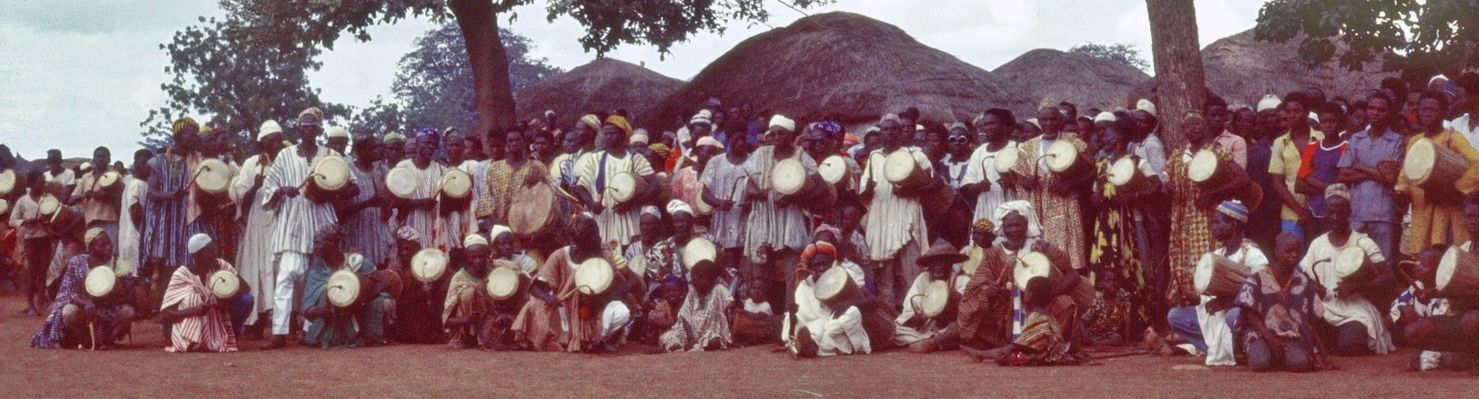
The accent color used for headings and dividers throughout the site complements the color palette of the photographic image on the main navigation pages, which is cropped to provide the banner-image on portal and supplementary pages, creating visual coherence between the site's design and its documentary content.
The posted copyright notice explicitly prevents modifications of content or commercial use. It reserves commercial rights but it permits accessing, copying, printing, and dissemination for personal or educational use. To encourage sharing, it requests but does not require attribution; therefore, it is more permissive than a Creative Commons BY-NC-ND license.
In addition to the dissemination of its primary informational contents, this electronic publication is intended to serve as a model in several regards.
Digital guidance for scholars
The site's technical structures offer guidance to other researchers for returning their research to their research communities. It demonstrates a functioning model consistent with archival standards to assist scholars in sharing their work and its legacy. The navigation menu on the five main portal pages has detailed source-code annotations (in HTML markup and CSS stylesheet commentary) on how the menu functions on both desktop and mobile without Javascript or other dependencies.
Digital publication
The publication expands the possibilities of open-access eBook publications, which are typically single-file replicas of hard-copy originals, often with non-flowable text.
Open-access
The site provides open access directly without institutional repository walls, gateways, or registrations, all of which contradict open-access intentions. Current repositories in general are not equipped for multi-file digital works of this complexity. The site's self-contained HTML structure is itself the archival format which needs no repository intermediary to function.
Archival preparation
If the site were transferred to an institutional archive, it could be hosted through a direct or redirected URL link. The site could be maintained and updated through simple file editing or file additions. No compilation, build process, or framework updates would be required.
Scholarly presentation without a CMS
The site achieves the organization and cross-referencing complexity of a major scholarly work entirely in standard HTML without a content management system. Navigation is maintained through consistent relative linking rather than programmatic generation. This approach is unusual for a work of this scale and makes the site exceptionally durable.
Offline distribution
The fully relative link structure means the site can be distributed on USB drives for use in locations with limited or without internet access, including schools and institutions in Ghana. This was a specific design goal to facilitate the return of project results to a major intended audience.
Separation of text and media
Chapter texts, audio recordings, and image galleries are maintained as separate files linked from chapter portals, rather than embedded in single pages. This modular structure allows each component to be accessed independently, updated without affecting others, and loaded efficiently on slow connections.
Dual audio delivery in different compressions
This intentional duplication, with the choice presented clearly to the user, reflects recognition of the diversity of internet access conditions among potential users, particularly with regard to Ghana and West Africa where the subject matter has a primary cultural relevance.
Multiple format presentation
Chapters contents and ancillary supporting content are provided in HTML and PDF formats: HTML for inline viewing with navigation, PDF for downloading and printing. Media are similarly available: JPG and MP3 for direct image viewing or direct audio access, for downloading, or for reposting. Users will not have to convert between formats for different contexts.